The Fundamentals

Fundamentals of a New Movement


The overarching, basic fundamentals of a New Movement are listed here. The link leads to the relevant post below. Also see "The Fundamentals" post list to the lower right. This is our new path. If you agree with this direction, then join with us.


The Old Movement is dead. Let us instead build something that works, a New Movement, a fresh start.


Showing posts with label Spengler. Show all posts

Friday, October 4, 2024

Diagnostic Pseudomorphosis

Spenglerian thoughts.

In this essay, I will use the Spenglerian concept of Pseudomorphosis, and the idea that an embryonic/early High Culture suffering from Pseudomorphosis will exhibit resentment and hostility to the offending established High Culture, to diagnose the presence of a very early stage new High Culture, and to gain some insights into its characteristics. To illustrate this possibility, I will use my idea of an Overman High Culture as a model.

See this. White Nationalism 3.0 alert - a Turk writes for Counter-Currents attacking Russians. The Counter-Currents article is well-written and does in fact make several interesting arguments, although some commentators point out how the thesis of that article is being over-stretched to fit a potentialy misleading narrative. Of course, questioning motives instead of arguments would be ad hominem, so I will not ascribe the article to the historical grievances of Turks against Russia nor of that of homosexuals against Putin's Russia.

My “take” on this issue is as follows and is based not only on my reading of history, but also “anecdotal” real-life experience knowing a reasonable number of Eastern European immigrants (real Eastern Europeans, not Jews), as well as having travelled in Eastern Europe, staying with private citizens, not in hotels, and meeting a variety of people. Russia can be considered a separate civilization from the West but it is not necessarily hostile; Russian-Western relations is contingent on history. Being invaded by Swedes, French, and Germans has not helped. If Russia was treated differently after the “end of the Cold War” then the situation today could be quite different. I agree that there are some civilizational tensions between Russia and the West but there is also opportunity for cohesion and collaboration, as two heads of a single European organism. As regards non-Russian Eastern Europeans (especially the Orthodox), while they are not fully of the West, they are not fully non-Western either. They fall somewhere in between the West and Russia, with the Catholic ones being more oriented toward the West, and the Orthodox ones more oriented toward Russia (culturally, not politically), but they are all (potentially) assimilable to the West. The Faustian Western High Culture - not the modern degeneration of it - has possibilities in Eastern Europe. Even Yockey (an extreme Western chauvinist) wrote, in The Proclamation of London, that there were elements in Russia amenable to the West.  

A general thesis of Spengler, O'Meara, and the Counter-Currents article is that Russia may be the center of its own High Culture, which is still in its early embryonic form. Of course, any High Culture can only arise if the human material is there, and a “Russian High Culture” cannot arise without the Russian people, who are being race replaced as are all other Whites. One other thing – High Cultures, and civilizations in general, are emergent properties of large numbers of particular Race-Culture types living in a defined territorial space. Let us assume that Russia is indeed a separate civilization. However, small numbers of Russians can assimilate into the Western culture. Certainly, Russian-Americans do not behave significantly different from other White Americans. However, masses of Russians, living amongst themselves – particularly on their native soil to which they have a historical connection – will likely manifest civilizational differences to the West. Just as a crowd takes on a distinct “personality” independent of the individuals of which it is composed, so does a culture emerge from a mass effect. Also see this for a more materialistic explanation for the adherence of certain peoples to particular cultural forms as part of their “racial soul.” The emergent “twist” on the idea in that "empirical racial soul" post is that these tendencies may be weak on an individual basis, but manifest in a synergistic fashion when masses of similar “racial souls” congregate together. An individual, or small groups of individuals immigrating over a period of time, likely will, or can, assimilate into another cultural form, but a large group introduced, particularly en masse, into an different culture likely will not.

The same Turk elsewhere:

Wouldn’t it be amazing if Eastern and Northern Europe were the most powerful and influential among Western countries? Oh wait… They can be. Time for Intermarium.

Surprise! A Non-European Caucasian (NEC) wants to divide Europeans, and exclude Southern Europeans from a narrower White subgroup. I am shocked, shocked I say!  Indeed, it is almost as shocking and surprising as the sun rising in the morning.

If only, say, Germany and the UK would be as “powerful and influential” in Europe as Italy or Greece...If only the power center in France would be in Paris in the north rather than Marseille in the south…If only Sweden was as influential in Europe as Portugal, if only Madrid was as influential as Brussels. Oh wait…

Note to mendacious alien Turk - Northern Europe IS the "most powerful and influential among Western countries." That is precisely why we are in the predicament we are in.

You can always count on NEC concern trolls to attack the Pan-European ideal, either directly or indirectly. Every. Single. Time.

Back to the Counter-Currents article: 

He termed such cultural amalgamation where a certain cultural realm is forced to express itself under alien cultural forms imported or imposed from elsewhere as Pseudomorphosis. Oswald Spengler thus predicted a century earlier that Russia will be moving away from the European (Faustian) Civilization and asserting its own unique identity.

One vivid example of historical Pseudomorphosis is the pre-Islamic Middle East, which Spengler called Magian Culture, being dominated by Rome and hence forced to express itself through the forms of Graeco-Roman (Apollonian) Culture, which was entirely alien to it. Only with the advent of Islam did the Magian Culture free itself from Graeco-Roman influence and could express itself organically in line with its own nature.

It is therefore quite likely that Russia is undergoing a process similar to that which the Middle East underwent in the 6th and 7th centuries, when with the rise of Islam, it emphatically asserted its own nature. As a matter of fact, throughout the centuries of Roman rule and domination of the Classical cultural norms the Middle East was seething with apocalyptic hatred towards Rome and everything Roman. In this regard, Islam can be viewed as the consummate form of expression of the deepest longings of the Magian world. At the same time, it was the medium through which the ressentiment towards the Graeco-Roman culture manifested itself. The intensity of that ressentiment was huge due to centuries of cultural suppression under Rome and being forced into the mould of the forms of Apollonian Culture, which were unnatural to the Magian Culture.

This explains the enmity the Islamic (i.e. Magian) world today manifests towards the West, which is represented by Christianity and which they view as the continuation of Rome…

…Importantly, the liberation of an emerging culture from the grip of Pseudomorphosis often unleashes a deep-seated hatred and ressentiment toward the dominant culture that once suppressed it. This phenomenon can be observed across various historical contexts…The Crusades can therefore be seen as the Faustian world’s emphatic rejection of the Eastern cultural dominance that had constrained it for centuries, marking a decisive moment in the assertion of Western identity and independence.

The following analysis in my post is based on the premise that Pseudomorphosis is a valid concept and the idea that it can breed resentment and hostility is correct.

According to Wikipedia:

The concept of pseudomorphosis is one that Spengler borrows from mineralogy and is introduced as a way of explaining what he calls half-developed or only partially manifested Cultures. Specifically, pseudomorphosis refers to an older Culture or Civilization being so deeply ingrained that a young Culture cannot find its own form and full expression of itself. In Spengler's words, this leads to the young soul being cast in the old molds, young feelings then stiffen in senile practices, and instead of expanding creatively, it fosters hate toward the older Culture.

Spengler believed that a Magian pseudomorphosis began with the Battle of Actium, in which the gestating Arabian Culture was represented by Mark Antony and lost to the Classical Civilization. The battle was different from the conflict between Rome and Greece, which had been fought out at Cannae and Zama, with Hannibal being the representative of Hellenism. He said that Antony should have won at Actium, and his victory would have freed the Magian Culture, but his defeat imposed Roman Civilization on it.

In Russia, Spengler saw a young, undeveloped Culture in a pseudomorphosis under the Faustian (Petrine) form. He said that Peter the Great distorted the tsarism of Russia to the dynastic form of Western Europe. The burning of Moscow, as Napoleon was set to invade, he described as a primitive expression of hatred toward the foreigner. In the following entry of Alexander I into Paris, the Holy Alliance and the Concert of Europe, he said that Russia was forced into an artificial history before its culture was ready or capable of understanding its burden. This would result in a hatred toward Europe, which Spengler said poisoned the womb of an emerging new Culture in Russia. While he does not name the Culture, he said that Tolstoy is its past and Dostoyevsky is its future.

It is possible that a new High Culture emerges without ever having had experienced Pseudomorphosis. But let us focus on the possibility that Pseudomorphosis does in fact take place. Imagine a new High Culture – the very earliest stages, the “pre-cultural” phase as well as the earliest glimmers of the new civilization – arising on the territory occupied by the old, preceding, late stage High Culture. You would expect the new High Culture, particularly as it physically overlaps the old and is subject to the sociopolitical power of the old, will suffer from Pseudomorphosis, and will exhibit resentment toward the older culture.

Let us forget about the Russian High Culture for a moment. The focus of this essay is this – if a purely European (including the Diaspora) new High Culture is emerging, or will emerge, among the ruins of the Faustian Western Culture, then what signs would be observed of this based on the phenomenon of resentment due to imposed Pseudomorphosis? Would these signs point to us the existence of a possible new High Culture and of some possible characteristics that it will manifest? In other words, can we use a diagnostic Pseudomorphosis, observing reactions to possible Pseudomorphosis to diagnose the existence of pre-cultural or early state High Culture and to identify its characteristics? I would think that any future European High Culture would, if it is in any sort of existence today, be in the exceedingly early pre-cultural stage. Therefore, one would need to look extremely hard for this embryonic culture, and try very hard to dissect out signs of resentment of that early cultural form toward the older culture among all the "background noise" of modern life.

Further, one needs to look for such resentment coming specifically from the Right, particularly the Far Right. Why? Two reasons. 

First, we are considering here only potential purely European High Cultures. Whether or not some type of non-White, mixed-raced, multiracial High Culture emerges is of no interest to me. By definition it is not what I am looking for. The Left is opposed to the survival of European peoples and, to be honest, the Mainstream Right is as well. Only the Far Right is focused on saving European peoples and so it is reasonable to expect that a new European High Culture will emerge from a milieu that is purely European and that is focused on preserving the European peoples. One cannot expect a purely European High Culture to emerge from a multiracial morass intent on exterminating Europeans.

Second, one would expect to see resentment from the Left with respect to the West under all circumstances, regardless of Pseudomorphosis. How can one tease out leftist resentment toward the West due to Pseudomorphosis (that would be imposed on a possible embryonic Left-Woke High Culture) from run-of-the-mill leftist hatred of the West and Whites, or from hatred toward the West from non-White civilizational blocs that already exist? One could not distinguish the signal of a Pseudomorphosis-driven resentment from the background noise of generalized leftist and non-White hatred of the West. Never mind that it is unlikely that the degeneracy of the Left, the mish-mash of multiculturalism, will give birth to any new High Culture – it is the opposite of High Culture and anathema to civilization. On the other hand, the Far Right is typically well disposed to the Western High Culture, and does not naturally have resentment to that High Culture. Therefore, the presence of anti-Western Far Right resentment should be a diagnostic clue, a warning sign, a ringing alert bell that something is going on, and that something could be resentment due to an embryonic new European High Culture suffering from Pseudomorphosis from the Faustian West.

Three caveats: First, with respect to Pseudomorphosis, the resentment from the Far Right has to be against the authentic Faustian Western High Culture, not the degenerate “West” exemplified by the Woke Left System. Second, the resentment cannot be in the form of resentment based on adherence to old, passed cultural forms, e.g., hostility to Christianity because one adheres to Classical Greco-Roman values or because one is an Odinist pagan. The resentment has to derive from the suppression of a new value system, a new cultural form. Third, although resentment from a political and artistic direction is expected from the (Far) Right in the scenario described here, it is also possible to have, in certain contexts, apolitical resentment as well. This apolitical resentment would likely come from the realm of science. Most scientists today are leftists and would share the typical generalized leftist resentment of the West described above. However, among more objective, apolitical, dispassionate White scientists, demonstrations of cultural resentment, or even frustration, may be a sign of a reaction to Pseudomorphosis. Of course, the few rightist scientists, typically well disposed toward the West, can be particularly useful "canaries in the coal mine" with respect to possible resentment toward the West - if even they demonstrate such resentment in particular contexts, what does that tell us? Perhaps it is a reaction to Pseudomorphosis in the realm of science and due to frustration with the underlying metaphysics of the dominant older culture. So, resentment due to Western Pseudomorphosis does not necessarily have to be politically rightist, it could be apolitical (as in science), but it most definitely would not be expected from the Left.

In my Overman essay, I wrote:

…of course a High Culture is an organic phenomenon that cannot be created in a pre-planned form and artificially imposed on a people. However, it is possible to plant the seeds and to have some choice as to which seeds are planted. And then, we can nurture the seedling as it grows, and as it develops according to its own inherent character. This we can do and this we must do.

Of course dogmatic Spenglerians would reject that idea of "planting seeds," and also reject the idea that we can predict the form a new High Culture would take. But I am not a dogmatic Spenglerian, so let us proceed with my hypothesis outlined in this post, based on its assumptions of analyzing a model system of a potential new High Culture.

Therefore, I will use my Overman idea as a model for this analysis. I know others have offered alternative possibilities for a future European High Culture. One example is a High Culture based on Spenglerian cyclicity; thus, instead of a worldview based on upward-looking Faustian overcoming, it will instead be based on a view that everything moves in cycles and the entire metaphysics and epistemology and cultural artifacts of the society would be based on that. However, I see it as too convenient to use Spengler’s central idea to predict a High Culture based precisely upon that central idea. Of course, others would make similar critiques of my Overman High Culture; they would argue that it is too convenient for someone from a Faustian High Culture to predict a new High Culture than further transcends the Faustian in its upward impulses. Very well. But we cannot really predict any of this, so I will proceed with my Overman-based analysis; I have already made clear that it is being used as a model system to illustrate how potential reactions to Pseudomorphosis could be used to diagnose these issues. 

Just as Yockey talked about several types of Culture Disease, here I discuss Culture Diagnosis. The overall idea applies to whatever form a new High Culture may take, as long as Pseudomorphosis and a reaction to that is present. If there is no Pseudomorphosis then obviously one cannot base diagnostics on that, and would simply need to be attuned to what the early, embryonic stages of a new High Culture would be like, which is a much more general non-specific approach. Is speculating about High Cultures itself an embryonic form, or sign, of such a culture? Who knows? But back to Pseudomorphosis.

What exactly is the Faustian Western High Culture? See here. That is a somewhat confused essay. Duchesne argues – as Oliver did and I once did (I have changed my mind on this after reading Quigley) – that Ancient Greece and Rome at least partially fit with the Faustian ideal. But then he, somewhat approvingly, cites Spengler’s idea of the Nordic origins of Faustianism.  Unfortunately for the Nordicists, current available genetic data do not support that the Ancient Greeks and Romans were Nordic. If the Faustian ideal is Nordic and if the Ancient Greeks and Romans exemplified this ideal before the historical emergence of Germanic Faustianism, but the Greeks and Romans were not Nordic, you have a problem. You could of course just say the Faustian idea is European – that would also fit with the Faustian Portuguese explorers who also were not Nordic – but Nordicism is an obsession that is impermeable to facts and logic.

Side note: If the focal point of the birth of the modern West according to Quigley was France (I suppose Spengler would stress the Germanic peoples) and if we accept Quigley’s idea that a new culture springs up, in a geographic sense, on the periphery of the old (e.g., France compared to the Greco-Roman world), then perhaps a new European High Culture will originate in Southern and/or Eastern Europe (by Eastern I would exclude Russia if we are to accept that they are potentially birthing their own High Culture), which are on the periphery of France and Germany, whuch are generally considered the center of the Faustian cultural form.

Duchesne writes:

If I had to choose one word to identify the uniqueness of the West it would be “Faustian.” This is the word Oswald Spengler used to designate the “soul” of the West. He believed that Western civilization was driven by an unusually dynamic and expansive psyche. The “prime-symbol” of this Faustian soul was “pure and limitless space.” This soul had a “tendency towards the infinite,” a tendency most acutely expressed in modern mathematics. The “infinite continuum,” the exponential logarithm and “its dissociation from all connexion with magnitude” and transference to a “transcendent relational world” were some of the words Spengler used to describe Western mathematics. But he also wrote of the “bodiless music” of the Western composer, “in which harmony and polyphony bring him to images of utter ‘beyondness’ that transcend all possibilities of visual definition,” and, before the modern era, of the Gothic “form-feeling” of “pure, imperceptible, unlimited space” (Decline of the West, Vol.1, Form and Actuality [Alfred Knopf, 1923] 1988, pp. 53-90).

This soul type was first visible, according to Spengler, in medieval Europe, starting with Romanesque art, but particularly in the “spaciousness of Gothic cathedrals,” “the heroes of the Grail and Arthurian and Siegfried sagas, ever roaming in the infinite, and the Crusades,” including “the Hohenstaufen in Sicily, the Hansa in the Baltic, the Teutonic Knights in the Slavonic East, [and later] the Spaniards in America, [and] the Portuguese in the East Indies.” Spengler thus viewed the West as a strikingly vibrant culture driven by a type of personality overflowing with expansive impulses, “intellectual will to power.” “Fighting,” “progressing,” “overcoming of resistances,” battling “against what is near, tangible and easy” — these were some of the terms Spengler used to describe this soul (Decline of the West, pp. 183-216).

A variety of words have been used to describe or identify the peculiar history of the West: “individualist,” “rationalist,” “imperialist,” “secularist,” “restless,” and “racist.” Spengler’s term “Faustian,” it seems to me, best captures the persistent, and far greater, originality of the West since ancient times in all the intellectual, artistic, and heroic spheres of life.

Wikipedia states:

According to Spengler, the Faustian culture began in Western Europe around the 10th century, and had such expansionary power that by the 20th century it was covering the entire earth, with only a few regions where Islam provided an alternative world view. He described it as having a world feeling inspired by the concept of infinitely wide and profound space, the yearning towards distance and infinity.[clarification needed] The term "Faustian" is a reference to Goethe's Faust (Johann Wolfgang von Goethe had a massive effect on Spengler), in which a dissatisfied Intellectual is willing to make a pact with the Devil in return for unlimited knowledge. Spengler believed that this represented the Western Man's limitless metaphysic, unrestricted thirst for knowledge, and constant confrontation with the Infinite.

In my Overman article, I quoted an older version of the Wikipedia article that importantly stated:

His description of the Faustian civilization is one where the populace constantly strives for the unattainable—making Western Man a proud but tragic figure, for while he strives and creates he secretly knows the actual goal will never be reached.

Note: "unattainable." To which I wrote in my Overman essay:

Here we see two defining characteristics of the “Faustian” civilization of the modern (i.e., post-Classical) West: first, a focus on infinity and the unknown, and second, that the striving toward that focus will always be unsuccessful; the objectives of Western Man are always “unattainable.”…

…I would argue that the Christian foundation of the Faustian High Culture is responsible for the fact that the ultimate goals that Western man strives toward end up being “unattainable”—and secretly known by him to be “unattainable.” The Christian mindset places inherent limits within the mind of Western man, so he is doomed to ultimately fail even if full success is theoretically possible…The full development of Western man has been restrained by an alien religion that has placed shackles on his mind and his soul…The motto of the Classical World was “Know Thyself,” while that of the Faustian Age was a combination of “Thou Shalt Not Know” with “Thou Shalt Try to Know and Thou Shalt Fail.” I propose that the new High Culture of the West have the motto: “Thou Shalt Know and Thou Shalt Overcome.” This will usher in an era in which Western Man unlocks his potential by unlocking the shackles imposed by an assumed inferiority to imaginary gods…In other words, no imaginary gods. It is Man that will become “God.”…No more “proud, tragic” failure in “striving for the unattainable” in the “Faustian” culture—instead the Overman Culture will be characterized by the proud successful attainment of the infinite. That is what a hopeful individual can project as the new High Culture of the West, with links to the Classical and the Faustian, but surpassing both in the aim and objective of the human spirit. 

So, we begin to observe differences between the Western (Faustian) and Overman High Cultures.

Another difference that I now add to my original thesis is that while the Faustian culture has the view of unlimited expansion upward and outward, the Overman culture has that view AND an unlimited expansion inward and downward as well, thus not only to the macro infinity but also to the micro infinity. Further, the Overman High Culture has a worldvieview associated with entangled essences, and relative frames of reference. Thus, from a metaphysical standpoint – and please forget for the moment about “Jewish influences” (e.g., agonizing over Einstein) – is it possible that such things as quantum mechanics and relativity theory are not merely the “materialistic degeneration” of the Winter of the West, but the seeds of a new formulation in opposition to Western ideas of classical reality and Newtonian mechanics? The inward expansion is suggested by quantum mechanics, nuclear physics, and genetics (and the whole molecular and cellular basis of life, in contrast to organismal and comparative anatomy) – thus, micro infinity. Entangled essences and relative frames of reference are associated with quantum mechanics (micro infinity) and special relativity (macro infinity), respectively. General relativity yields a quite different metaphysical view of space and gravity - macro infinity - than Newtonian physics does. In the old view, time flows; in the new metaphysics, time is a compilation of static realities connected by causality. The outward impulses toward the infinite are in one sense constrained by these new theories, but in another sense liberated from clockwork Newtonian and Copernican ideals, possibly opening up novel ways to break through the “try to transcend and fail” limitations of Faustianism. Perhaps the Faustian inevitably fails because its metaphysics sets it up for failure by not understanding views of realty that would be better comprehended by a different culture. Perhaps there is Pseudomorphosis at work here. Thus, we cannot understand the underlying realty of these new metaphysical laws because our way of thinking is constrained by Western Newtonian metaphysics. We believe that we are rejecting Newtonian ideals, but those ideas are so part of our worldview that the proper development of the alternative metaphysics is stifled. We believe that we are rejecting the old ways of thinking but we are still prisoners of them, and then fume in frustration when we come up against unknowns and “paradoxes” that seem to emerge from the new metaphysics. 

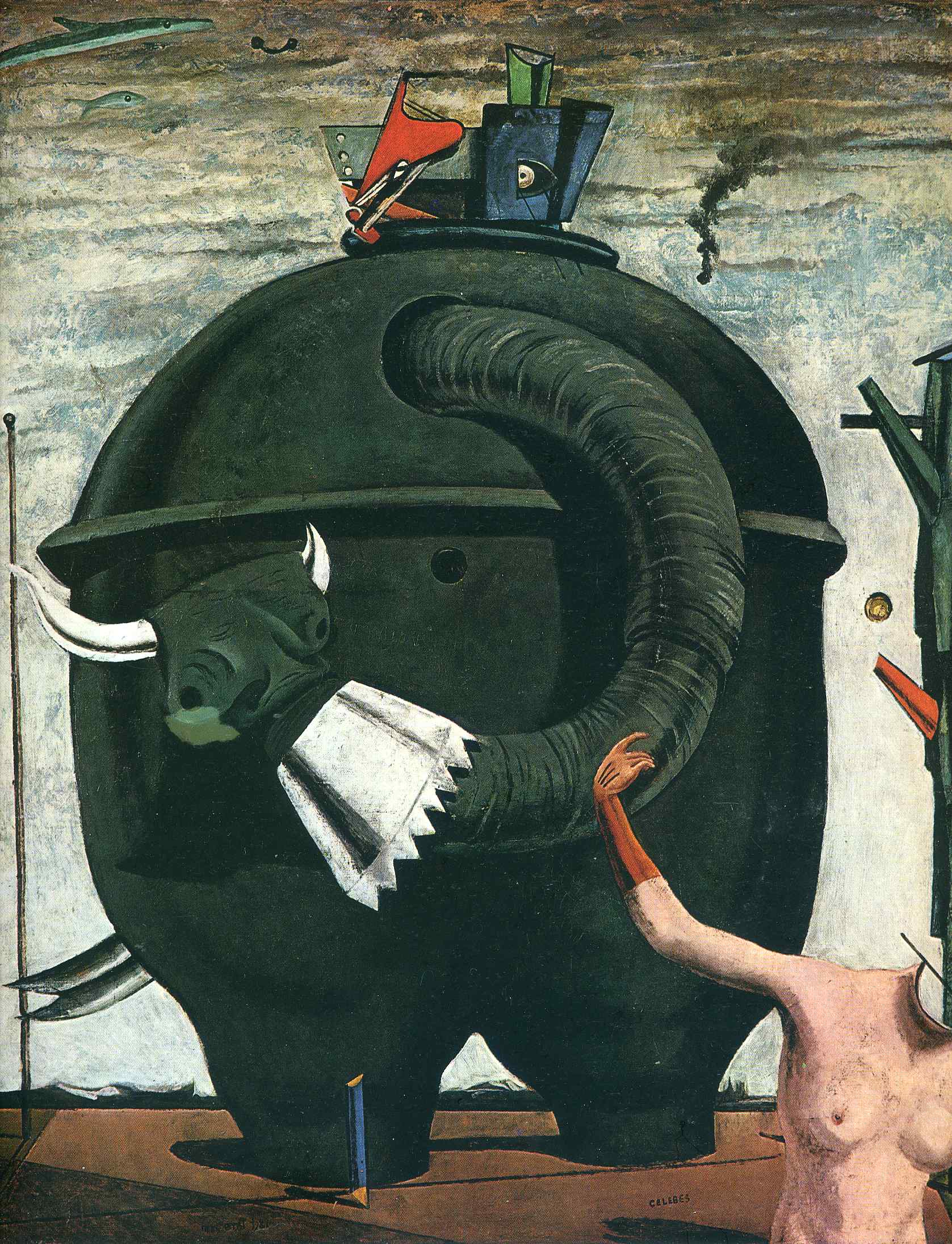
The same Pseudomorphosis may hold true in art. An archetypical expression of the Western soul is this, which is valued as a high form of expression by those who adhere to the Western tradition. However, such traditional Western art forms may be suffocating alternative artistic expression from a new High Culture, an embryonic example of which may be thisA representative of the Western culture would look at those two images and think that the David is a perfect example of Western artistic beauty that speaks to the Faustian soul, while the Chronos is a degenerate monstrosity. A representative of the Overman culture would acknowledge that the David is an important piece of work and would instrumentally value it as a creation of European genius (just as Westerners can admire products of the Classical civilization), but they would view the Chronos as representing the soul of the Overman civilizational worldview. And, yes, there may well be resentment that the Western art forms (e.g., David) are dominant within the rightist milieu and that more futurist cultural artifacts (e.g., Chronos) are dismissed and not properly comprehended. This here is another example of an artwork that may resonate more with an embryonic Overman sensibility while being rejected by Western traditionalists as “degenerate." Also consider this as another representation of a new artistic sensibility perhaps not properly understood by the defenders of the Western tradition..

We can bridge the gap from art to politics by considering futurism. Was the futurist movement an example of late stage Western culture, or was it a protest by an embryonic High Culture against the Pseudomorphosis imposed by Western art forms and by Western sociopolitical conventions? Note the importance of Italy in the futurist movement – was that an example of an embryonic High Culture emerging on the periphery of the Franco-German epicenter of the modern West? A radical idea – what if the Romanian Legionary Movement suffered from Pseudomorphosis by their embrace of Christianity as a core of their belief system? What if the New Man was actually the authentic core of that movement, reflective of the values of an embryonic new European High Culture (again in the periphery of the older, established Western one, given the geographic location of Romania), and so could one find in some of the more aggressive cult-like activities of the Legion hidden resentment against this Westernized Christian Pseudomorphosis?

Are all these things signs of resentment against Pseudomorphosis imposed by the Faustian culture? We observe the new scientific perspectives that aggressively reject old structures but find themselves struggling to articulate their metaphysics in a manner truly independent of the old. We see artistic movements that aggressively reject old forms. Fascism was perhaps a political revolt against Western political forms – Pseudomorphosis here was manifested by the defeat of Fascism by the democratic and economic (including Marxism) axes of the late-stage West, akin to the Magian High Culture being defeated by the Apollonian/Classical High Culture at Actium. Also note the links between futurism and Italian fascism. One wonders. Is the Yockey Imperium idea characteristic of a late stage Western High Culture or is it an idea that instead fits better with a fresh civilizational perspective?

Moral and ethical resentment against Western Christianity from a Nietzschean perspective may fit here – was Nietzsche less of a figure of old Western culture and more a Dostoevsky-like figure of an embryonic new High Culture? Certainly, Nietzsche – despite his tirades against ressentiment – demonstrated much hostility to restrictive old Western moral and ethical forms.

Let us consider Francis Parker Yockey, a paragon, an aggressive defender, of the Western Faustian High Culture. Yockey in Imperium (emphasis added) demonstrates his inability to understand the new science, exactly what one would expect from a representative of one High Culture trying to understand the metaphysics of another:

The down-going of science as a mental discipline had long preceded the World War. With the theory of Entropy (1850), and the introduction of the idea of irreversibility into its picture, science was on the road which was to culminate in physical relativity and frank admission of the subjectivity of physical concepts. From Entropy came the introduction of statistical methods into systematic science, the beginning of spiritual abdication. Statistics described Life and the living; the strict tradition of Western science had insisted on exactitude in mathematical description of reality, and had hence despised that which was not susceptible of exact description, such as biology. The entrance of probabilities into formerly exact science is the sign that the observer is beginning to study himself, his own form as conditioning the order and describability of phenomena. 

The next step was the Theory of Radioactivity, which again contains strong subjective elements and requires the Calculus of Probabilities to describe its results. The scientific picture of the world became ever more refined, and ever more subjective. The formerly separate disciplines drew slowly together, mathematics, physics, chemistry, epistemology, logic. Organic ideas intruded showing once more that the observer has reached the point where he is studying the form of his own Reason. 

A chemical element now has a lifetime, and the precise events of its life are unpredictable, indeterminate. 

The very unit of physical happening itself, the ―atom,‖ which was still believed in as a reality by the 19th century, became in the 20th century a mere concept, the description of whose properties was constantly changed to meet and prop up technical developments. Formerly, every experiment merely showed the ―truth‖ of the ruling theories. That was in the days of the supremacy of science as a discipline over technics, its adopted child. But, before the middle of the 20th century, every new experiment brought about a new hypothesis of ―atomic structure.‖ What was important in the process was not the hypothetical house of cards which was erected afterwards, but the experiment which had gone before. 

No compunction was felt about having two theories, irreconcilable with one another, to describe the ―structure‖ of the ―atom,‖ or the nature of light. The subject-matter of all the separate sciences could no longer be kept mathematically clear. Old concepts like mass, energy, electricity, heat, radiation, merged into one another, and it became ever more clear that what was really under study was the human reason, in its epistemological aspect, and the Western soul in its scientific aspect.

Scientific theories reached the point where they signified nothing less than the complete collapse of science as a mental discipline. The picture was projected of the Milky Way as consisting of more than a million fixed stars, among which are many with a diameter of more than 93,000,000 miles; this again as not a stationary cosmic center, but itself in motion toward Nowhere at a speed of more than 600 kilometers a second. The cosmos is finite, but unlimited; boundless, but bounded. This demands of the true believer the old Gothic faith again: credo quia absurdum, but mechanical purposelessness cannot evoke this kind of faith, and the high priests have apostatized. In the other direction, the ―atom‖ has equally fantastic dimensions — a ten-millionth of a millimeter is its diameter, and the mass of a hydrogen atom stands to the mass of a gram of water as the mass of a post card stands to the mass of the earth. But this atom consists of ―electrons,‖ the whole making up a sort of solar system, in which the distances between the planets is as great, in proportion to their mass, as in our solar system. The diameter of an electron is one three-billionth of a millimeter. But the closer it is studied, the more spiritual it becomes, for the nucleus of the atom is a mere charge of electricity, having neither weight, volume, inertia nor any other classic properties of matter. 

In its last great saga, science dissolved its own psychical foundations, and moved outside the world of the senses into the world of the soul. Absolute time was dissolved, and time became a function of position. Mass became spiritualized into energy. The idea of simultaneity was discarded, motion became relative, parallels cut one another, two distances could no longer be said absolutely to equal one another. Everything which had once been described by, or had itself described, the word Reality, dissolved in the last act of the drama of science as a mental discipline.

Let us focus on this excerpt from Yockey’s diatribe:

…the strict tradition of Western science had insisted on exactitude in mathematical description of reality, and had hence despised that which was not susceptible of exact description, such as biology. The entrance of probabilities into formerly exact science is the sign that the observer is beginning to study himself, his own form as conditioning the order and describability of phenomena. 

Thus, we see the contrast between the metaphysics of the Faustian West and the metaphysics of what could be the embryonic beginning of a new High Culture.

It is true that we do not observe scientists demonstrating overt resentment and hostility based on contrasting metaphysics, but that may be expected from a group that allegedly represents objective rational academic dispassionate discourse.  What we observe instead is frustration due to a lack of understanding of the new concepts, and due to the fact that a thorough understanding of the new metaphysics may be impeded by viewing everything through the lens of Western metaphysics. Of course, the majority of scientists, who are on the Left, do in fact demonstrate resentment and hostility toward the West, but this is derived from leftist political ideology, not metaphysics. The White Left shares the same basic metaphysics as does the West and that metaphysics is not compatible with a true understanding of the newer concepts. Further, the reason non-White scientists are unable to fully understand these concepts would not be due to Pseudomorphosis (as it is with rightist or apolitical Whites) but simply because these new concepts derive from an embryonic High Culture that derives from Europe and from which an inner spiritual connection is barred to non-Europeans. Note that I do not sense the same frustration from non-Whites concerning these concepts, simply a lack of full understanding that they, as culture aliens, accept with more equanimity.

Let us back up a bit. How can we succinctly describe the basic metaphysics of relevant civilizations?

The basic metaphysics of the Apollonian/Classical High Culture was said to be locality - the present time (locality in time) and locality in space, the Magian High Culture was focused on “the world as cave or cavern,” and the Faustian/Western High Culture was (and is) characterized as "thrusting upward into infinite space.” The Overman High Culture instead could have a metaphysics of reality as information, observation, interaction, structure, and space expanding infinitely both outward and inward.  Thus, we observe the primacy of genetic information as opposed to phenotype (see my work, pssobly rpresentative of the new perspective?), quantum mechanics (observation, interaction), relativity theory (structure of spacetime), nuclear physics, etc. Quantum mechanics and nuclear physics expand inward, while relativity theory expands outward, but in a structured manner (e.g., Minkowski spacetime diagrams). The new perspective considers dimensionality as important, not only in spacetime but in the human experience. Let us consider the (first iteration of) opening of the famous TV series The Twilight Zone (putting aside complaints of “Jewishness”). The “fifth dimension” is one related to human experience and the unknown, and there is a sense of existentialism; indeed, a right-wing existentialism that is not traditionalist could delve into aspects of a new cultural zeitgeist.

I will actually answer the “but you are referring to Jewish activities” complaints. Yes, Jews are of the Magian High Culture and are not part of the West and I doubt that they will be part of any future European High Culture. But Jews are a clever people and as Yockey noted they know how to exploit other High Cultures to promote their interests, even their personal interests (fame, money, status, etc.), never mind their group interests. It is therefore possible that some Jews have sensed a change in the civilizational zeitgeist and therefore they formulate memes and activities that leverage interest in these changes.

Let us consider some examples. Relativity theory is “Jewish” but Einstein in his thought experiments extrapolated from the work of Maxwell and other Europeans to produce Special Relativity; General Relativity is a further extrapolation from the Special theory. So, relativity may be “Jewish” but it tapped into ideas originating among Europeans and (unknowingly) situated these ideas in a novel theory that could fit into the metaphysics of a new High Culture. Quantum mechanics and genetics, as well as information theory, have been mostly European products, with later Jewish contributions. Nuclear physics is a mixed European-Jewish affair; the original work was European. With respect to politics and the arts, fascism and futurism are of European origin. Note that the most “Avant Garde” fascism is French in origin and futurism has strong Italian connections. They are not Jewish. To the extent that The Twilight Zone reflected existentialist themes, existentialism is essentially European. So, we cannot say that in these things that Jewish influence was absolutely decisive, and in any case such influence reflects undercurrents that are ultimately of European origin.

To summarize with respect to possible manifestations of resentment and hostility of an embryonic new (Overman) European High Culture to Pseudomorphosis from the Western High Culture, we can say the following. In politics and the arts, the signs are more clear, and with respect to philosophy, Nietzsche and the existentialists may reflect this as well. The more dispassionate nature of science makes resentment and hostility more difficult to detect, but one can say there is, at least, frustration with respect to serious problems in being able to understand and articulate a new (scientific) metaphysics given limitations imposed by a Western Faustian background.

However, note that the major objective of this essay is NOT to “prove” that another European High Culture is coming, what its characteristics would be, that it is the Overman High Culture, and that we can see definitive signs of resentment and hostility due to Pseudomorphosis. No, instead the argument, based on using the Overman example as a model system, is that in theory we may be able to discern something about an embryonic High Culture by considering how Pseudomorphosis from an older High Culture may affect the newer form, and then looking carefully for reactions – resentment and hostility, or at least frustration – to point us in the direction of some characteristics of the new form and how it is being impeded by Pseudomorphosis.  Thus, the argument here is that Diagnostic Pseudomorphosis is possible. Whether such an exercise can yield useful information is another matter.

Friday, July 29, 2022

The Evolution of Civilizations

Book review.

See this.

What is a civilization?  How does it evolve?  How and why does it collapse?  We can consider Carroll Quigley’s ideas on these subjects, as outlined in The Evolution of Civilizations.

Quigley’s comments on science, scientific theory, and the scientific method are must reading, particularly for those on the Left (e.g., race deniers, sex/gender deniers) and the Right (HBDers, anti-vaxxers, covid deniers) who have a complete lack of understanding, or misunderstanding, of what science is (i.e., a method, not a constellation of “facts”) and how it works (see Quigley’s fine explanations).

Quigley describes the three ways of describing social groups and the consequences of each view. One approach is to view a social group as nothing more or less than a mere collection of individuals and the group being only the sum of its individual parts; this view promotes self-interested atomized individualism and intra-group competition, as here there is nothing of more importance than the individual and his needs.  This view would also be incompatible with the idea of a cultural tradition being handed down through the generations to form a civilization. At the opposite end of the spectrum is the view as the social group as an organism that is more than the sum of its parts, with individuals within the organism being non-interchangeable.  This view can lead to collectivist totalitarianism in which the rights of the individual are routinely sacrificed for the common good; after all, here the entity of importance is the societal organism, and as a non-interchangeable component of that organism, the individual must – emphasis on must – play their irreplaceable role as a key component, a required body part, of that organism.  Deviation from that role places the existence of the organism in danger, since the individual and their role are not interchangeable; hence, individual choice must be constrained.  The intermediate view is that that the social group is more than the sum of its parts, a novel entity that allows for positive group action and cultural transmission (hence, opposing atomized hyper-individualism); however, in this view individuals are interchangeable and hence to do not require their roles and choices to be tightly constrained.  Thus, if an individual chooses a different path, they can be replaced (as they are interchangeable) and the social group can survive allowing individual freedom since flexibility of social roles is compatible with group survival.  The collectivist organism view would consider the individual akin to a required organ in the social group’s body, the removal of which can kill the group body; the latter intermediate view would consider an individual to be more like a modular component of a machine that can be swapped out for another component, allowing each the flexibility to perform the role they are best suited.

As a conservative in the classic liberal tradition, Quigley seems to prefer the intermediate view that rejects atomized hyper-individualism but that embraces a more muted individualism that allows for group culture while rejecting totalitarian collectivism.  As a national socialist fascist, I prefer the collectivist organism view, and I observe evidence in history that the intermediate view inevitably degenerates into the hyper-individualist “collection of individuals” dystopia.

The basic social group, or social aggregate, can be merely a social group at its lowest level, or it can be a society or a civilization as one moves up in complexity. A (social) group is merely an aggregate of people who come together for a narrow purpose but who have more interactions with those outside the group than with those within; thus, to explain the personalities of the group will require more mention of those without than within the group.  A society on the other hand has more internal interactions than external, the individuals within a society have more interactions with each other than with those without and therefore to explain them and their personalities would predominantly require reference to those within the societal aggregation. Quigley notes that if one considers aspects of the broad culture to be interactions, then most nation states are actually groups rather than societies, since most interactions of those within those states involve concepts and entities bigger than the nation state and peoples of those larger entities.  For nation states of the West, that larger entity, the actual society, is Western Civilization. That analysis is, by the way, a major riposte to petty nationalist ethnonationalist and is supportive of Yockeyian pan-Europeanism.  One can argue that globalism has contributed to the decay of Western Civilization by degrading its exclusiveness and increasing the amount of interactions with concepts and entities outside the West, so that to explain the modern “West” reference to Western Civilization itself is no longer adequate and one must reference even more broad Universalist humanist concepts and entities.

Quigley wrote:

The essential thing about a group is that its members can say who is in it and who is not.

That's exactly what I've been saying about the "movement" for years - with its endless "Who is White?" debates and redefinitions and uncertainties, it cannot be even considered a group, much less a society. In fact, to be successful, a real movement needs to become more and more like a genuine society, to create a parallel society in which individuals interact more among themselves and can be explained predominantly by internal references.  Such a movement can save Western Civilization – or build the next European Civilization – by replacing the inclusive humanist corpse of the modern West with a self-contained exclusive society that represents a vibrant self-referenced civilizational aggregate. I note that Quigley asserts that a political unit is comprehensible – being able to be understood without reference to outside entities – only when it encompasses the entire society.  As he considered Western Civilization as a whole, and not its constituent nations (being only groups), to be a society of the West, then the only comprehensible Western political unit would be something like a Yockeyian Imperium.

Other distinctions are that of parasitical vs. productive societies, with the former using the Earth’s wealth without contributing to it (e.g., hunter gatherers), and the latter actively contributing to wealth (e.g., agriculturalists). Quigley makes a tentative preliminary (and very crude) definition of a civilization as a productive society that has writing and city life (the latter would upset the Type I “twigs and branches” “hobbit hole” “traditionalists” of the “movement”). Please note that Quigley modifies this definition to eliminate the “city life” part (to the “movement’s” relief).

Quigley notes that a “scientific” analysis of civilizations must take into account that human thoughts, opinions, and desires affect the trajectory of a civilization; hence, there will be more subjectivity involved as opposed to an analysis of physical laws, for example.

Quigley gives a digression on rational vs. irrational aspects of examining reality, and contrasts Platonic “rational” analyses that are independent of actual observation (and testing) and are hence anti-scientific to more positivist “irrational” observational analyses, which are complicated by reality being composed of continuous variables. Now, strictly speaking, that may not be true, given quantum theory, but let us assume Quigley is talking about practical real-world observations. Even so, he forgets that taking several (apparently) continuous observations at the same time can result on discrete categories as entities may be continuous on single variables taken in turn but are unlikely to be simultaneously continuous on a larger number of variables taken together, all of which can “fix” different entities into discrete spots on a multi-dimensional continuum.

Quigley makes an important distinction, relevant to us, of social instruments vs. social institutions.  A social instrument is a social organization composed of the sociopolitical (and other) technics needed to achieve the purposes of the subdivisions of a civilization’s basic needs (e.g., Intellectual, Religious, Social, Economic, Political, and Military). However, as a rule of history, “all social instruments tend to become institutions.” A social institution is a social organization that has taken on purposes independent of its original purpose and becomes less and less effective in performing its ostensible purpose. A self-interested, rent-seeking managerial elite takes over that pursues ends that dilute, or even conflict with, what the organization is supposed to be doing. Armed forces are a social instrument to achieve the military ends of a civilization.  Eventually it evolves into an institution more concerned with the career advancement of its leaders, maximizing military budgets, maintaining institutional cultures, getting involved in politics, and pursuing insane objectives like “social justice” and “equity.”  And so its effectiveness in fighting wars is compromised. Such transformations across the board in the various facets of a civilization contribute mightily to its eventual (inevitable?) collapse.  These transformations are met with attempts at reform, circumvention, or reaction. In reform, the instrument is temporarily restored to effectiveness and societal collapse is delayed. In circumvention, the institution retains its privileges but its duties are given to a more efficient new instrument, which itself inevitably degenerates into an institution (while the original institution carries on as a parasite on society).  Although circumvention is obviously less efficient and optimal than reform, it at least restores some effectiveness and can delay collapse.  In reaction, the institution resists all attempts at reform or circumvention, effectiveness and consequent societal dissatisfaction remains and collapse is hastened. These possibilities are termed “development” and so “historical development” describes the changes at one level of society; “historical morphology” describes different levels acting on one another, and “historical evolution” is the sum total the development and morphology acting simultaneously and acting upon each other.

Every civilization has an “instrument of expansion” that is manifest when the civilization is rising; when that instrument becomes an institution, and subject to all of the negatives of societal institutions, the civilization decays. The instrument of expansion is broadly concerned with three aspects of civilizational development: 1) inventing new entities, 2) producing and accumulating a surplus of wealth, and 3) leveraging that surplus to pay for and/or utilize the inventions of the civilization (i.e., using the surplus as an investment to promote progress). Note that at this point, Quigley redefines what a civilization is, since he notes that some civilizations (like the Western) had no significant city life during the early phases of their development. Thus, Quigley more refined definition of a civilization is “a producing society with an instrument of expansion.”

Unfortunately, Quigley blithely dismisses biological explanations about why some groups are more successful than others in these processes, particularly step 1(inventing) and, by extension, step 3 (leveraging surpluses to take advantage of those inventions).  Quigley’s argument basically boils down to the observation that the same peoples, at different times in their history and/or in different locations, may have been more or less inventive.  Putting aside the possibility that the “same people” may not be exactly the same over time, even if we assume that “same” really is same, then the basic problem with Quigley’s argument is that he ignored potentiality.  Yes, a people may not be inventive in a particular historical context, but if they exhibit inventiveness in another context, then we can say that they have a biological potential for invention.  What if another people, throughout their entire history, and in various historical contexts, invent nothing?  Can we not say that they lack the biological potential for invention?  And with respect to the peoples who have invented in different contexts, some may consistently invent more than others, assuming the appropriate historical contexts.  So, there is a spectrum of biological potentiality – high, medium, low, none.  Thus, for example, Europeans would be high, Asians would inhabit the medium and low range, while other groups would inhabit the low to none (e.g., Negroes) range.  Potentiality and actuality are two separate issues; however, to show evidence of potentiality, some actuality must at some point occur. We can also pass over in relative silence Quigley’s racial theories, no doubt influenced by the stupidities of “traditional physical anthropology” (and the tripartite Nordic-Alpine-Mediterranean concept) and the idea that historical round-headed stocky peoples were Homo sapiens-Neanderthal mixes, as opposed to others (in reality, in general, virtually all non-Negro peoples have Neanderthal admixture, and no way near as much as Quigley seems to imply for certain groups).  These racial theories (and all of his babbling about geography and climate) are irrelevant to his main theses, and need not concern us any further. One thing I’ll say though is that the general idea Quigley finishes this section with of Europeans as  a whole genepool being composed of hinter-gatherers, Neolithic farmers, and Indo-European steppe peoples is more or less accurate, although some of the dates he gives for some of these events and specific end results of peoples involved is “off.”

Getting back to the decline of civilizations, Quigley focuses on the problems ensuing when a civilization’s primary instrument of expansion becomes an institution, a degeneration that often occurs when self-serving managerial elites redirect society’s surplus away from investment in inventions (broadly defined) into “nonproductive” endeavors such as displays of status, conspicuous consumption, monuments, and other selfish endeavors that do not contribute to societal advancement. In this manner, the cycle of invention, surplus, and investment collapses and societal expansion ceases and stagnation and decline follow. This naturally causes tension in the society, as people in the society – who have been habituated to constant expansion – now observe a lack of expansion and downward mobility for themselves and for their posterity. Sound familiar?  Even back when Quigley wrote the book (published in 1961) he noted that “contemporary Western civilization” was exhibiting the problems consequent to a slowing down of expansion. Today of course these problems are much worse. Of course, reform or circumvention of this process can delay the inevitable, while reaction hastens the end.

Quigley notes that Western Civilization has gone through multiple cycles of reform, which seems unusual, and would seem to indicate the possibility for future renewal if the West was not destroying itself demographically (that last part is my interpretation. Thus, in 970-1270, the West has the instrument of expansion of feudalism that was institutionalized as chivalry. This problem was circumvented in 1420-1650 by the instrument of commercial capitalism (with the old feudal aristocracy being parasites keeping their old privileges even when no productive activity was derived thereof), which degenerated into the institution of mercantilism, which in turn was reformed into industrial capitalism (1725-1929), an instrument that became the institution of monopoly capitalism.  Note that these divisions are quite different from the culture vs. civilization paradigm of Spengler. Indeed, the terminology is different as well; what Quigley calls a “civilization” is analogous to the “High Culture” of Spengler/Yockey.  Thus, Quigley encompasses Spenglerian “culture” and “civilization” under the broad umbrella of “civilization.”  

Quigley divides the life of a civilization into seven phases:

1. Mixture

2. Gestation

3. Expansion

4. Age of Conflict

5. Universal Empire

6. Decay

7. Invasion

There are some correlations we can make with this to the Spengler/Yockey scheme.  Thus, phases 1-3 would be akin to the “Spring” culture phase, stage 4 to the culture to civilization crisis, moving to “Summer.” The height of civilization would be the Late Summer-Fall Universal Empire of stage 5. Late Fall is stage 6, and then we enter Winter at stage 7, as the High Culture dies.  Looking at our own situation, it seems like we are in stage 7, with mass migration into the West being the Invasion that destroys Western Civilization; further reform (or circumvention) seems unlikely, as the System’s reaction to Far Right attempts at reform is to double down on their institutionalized immigration instrument. We’ll see how that all ends. Note also that Quigley dispenses with concerns over “pseudomorphosis” and pointedly states that civilizations begin with Mixture – a mixing of elements of older civilizations, typically taking place at or near the geographical border between them. The Age of Conflict and subsequent decay typically occurs because of the institutionalization of the key instruments of expansion. In order for reform to occur, all three components of expansion need to be taken care of: invention, accumulation of surplus, and investment. The masses typically focus on redistribution of the surplus, which does nothing to enhance invention and investment, and the rent-seeking, self-interested elites resist any type of reform. More often circumvention occurs to bypass elite resistance and in many cases the emergence of a new instrument of expansion occurs by accident (to the extent that is possible). It would be optimal if institutionalization could be avoided in the first place, which is why rent-seeking, grifting, and free-riding needs to be quashed as quickly as they appear. Unfortunately, it seems almost inevitable that elites selfishly institutionalize instruments of expansion for their own benefit. Interestingly, peripheral areas of the civilization have delayed conflict and decay compared to the core area, in which it happens earlier, but eventually the elites wreck things and the masses are incapable of understanding anything beyond the fact that they are displeased with society’s direction and that they want the surpluses directed toward them in a desperate attempt to restore their lost upward mobility. Peripheral areas tend to conquer core areas during the age of empire building, not only because the core areas crisis first and are thus weakened, but because the peripheral areas tend to focus more on materialistic issues like technics and military power as compared to the cultural core that is more concerned with intellectual pursuits and abstractions.  Further, the core being more advanced on the historical timeline not only means it has entered crisis first, as mentioned before, but would be more exhausted from previous war and the population more “jaded” and less willing to endure sacrifice and more prone to “losing nerve” compared to the more vigorous peripheral areas.

A few more points about this scheme. To most people within the civilization, stage 5 seems like a “Golden Age” but this is a misleading surface prosperity.  At this point, the elites and their selfish interests have, for the most part, firmly entrenched their institutions, crushing reform through class warfare to oppress the masses, imperialism to distract from internal problems and create an artificial prosperity (e.g., substituting for a lack of internal intensive economic expansion with imperialistic extensive expansion), and irrationalism to mask discontent and distract the masses via various types of false prophets and crazy memes. Eventually, this is not sustainable and decay sets in, as living standards decline, the ability to project power diminishes, chaos increases, and the civilization loses the allegiance of the people. When then civilization is no longer able to defend itself because it is not willing to defend itself, it succumbs to some sort of invasion, and ends.  This end may result in the birth of a new civilization through mixture between the old destroyed civilization and new elements, including possibly the invaders themselves, but in some cases this does not occur. In my own opinion, I think stage 7 leads to a new stage 1 only when the new elements have innate (biological) potential for civilization and that they are biologically and culturally/spiritually not that different from the population of the destroyed civilization. I see little hope that anything useful will emerge from those destroying the West, nor would such a development be useful. 

The peoples of the West would need to build a new civilization by mixing new elements of their own making (and perhaps something borrowed from compatible people – like the Classical civilization, which was European) with the best of the West.  Also, civilizations are in danger of destruction only in their early or late stages, and a civilization in decay can even be destroyed by uncivilized “barbarians” – something that has occurred at various times in the past.  When two civilizations at or near their prime come into conflict, it is typically the one at stage 3 (or closes to that stage) that prevails, but the losing civilization is typically not destroyed (stage 7) unless it is at stage 6 (or maybe at stage 1 or early stage 2). 

A few more points of interest.  Quigley defines the Age of Conflict (stage 4) as being defined by “(1) decreasing rate of expansion, (2) imperialist wars, (3) class conflicts, and (4) irrationality.”  The parallels to today’s America and overall Western decline are obvious.  Related to this, Quigley defines capitalism as “a form of economic organization motivated by the pursuit of profit within a price structure” and that the instrument of expansion of commercial capitalism becomes institutionalized into mercantilism when the means of profits (originally meant to obtain the end of an improved standard of living and societal well-being) becomes an end to itself, to the detriment of the civilization. Again, behold America and the West. One can also find Age of Conflict parallels in the American pro-White “movement.”  Decreased expansion is evident in the collapse of the Alt Right and its consequences; imperialist wars are akin to, first, the attempt of the Alt Right to dominate the “movement” and now for the HBD-Nordicist-ethnonationalist alliance and WN 3.0 to do so; class conflict is akin to Amnats vs. Wignats; and as far as irrationality goes, while that has always been a hallmark of the American Far Right, it has gotten worse with the lunatic hysteria over the covid “death jab,” conspiritard theories (“viruses don’t exist” or “nuclear weapons are a hoax”), and the totality of hobbit hole traditionalism. With respect to how civilizations are born and die, Quigley emphasizes five practical steps: (1) law and order being established or lost, (2) long distance trade increasing or decreasing, (3) town and city life increasing or decreasing, (4) middle class prospering or disappearing, and (5) literacy increasing or decreasing – with, obviously, the increasing for each category associated with birth and decreasing with death.  In today’s West, all except #3 are decreasing (with #2 breaking down recently with supply chain disruptions); one can even question #3 as the breakdown of law and order (#1) makes city life more dangerous.  

Quigley on the Canaanite Civilization that gave us the Jews, besides being intelligent they were: “Vigorous, practical, almost crude; grasping, unesthetic…filled with sensual desires and crass superstitions…”  Sound familiar?  Oy vey!  Tribal kinship ties were important for these people (as they are today); further, Quigley suggests that the Jews originated with “Habiru” outcasts (surprise!).

The instrument of expansion for the Classical Civilization was slavery, which essentially doomed that civilization from the start.  That instrument was quickly institutionalized with absentee landlords running slave farms and misusing accumulated surpluses and even under optimal circumstances, slavery was an inefficient economic system and always stifles technological innovation.  Breaking up the large slave farming lands wouldn’t have helped in the end, since the distributed wealth wouldn’t have allowed for a concentrated accumulated surplus that could have been plowed back for invention and expansion; only a completely new instrument of expansion, from a new civilization (e.g., feudalism in the West) solved the problem. The inefficient slave economy, and other economic problems, did not allow the later (Western) Roman Empire to field the mass cavalry required to beat back barbarian invasions at a time when cavalry began to replace infantry as the cutting edge of military technology. Even earlier, slavery in Greece not only hampered innovation for the obvious reason that slave labor made technology less immediately and obviously necessary, it also discouraged simple improvements in agricultural efficiency – if agriculture became more efficient and less labor and time intensive, then what would be slaves be doing during the time they were now idle?  It seems like an inefficient economy was a price paid to maintain an aristocratic, hierarchical master-slave society (the Antebellum American South seems to have suffered from the same problems).

Quigley states what in his mind was the defining characteristics of the classical world; of these, the most important to me are its emphasis on aristocratic and hierarchical values, the willingness to sacrifice material well-being for honor, for dignitas, for all of these aristocratic and hierarchical values (as with the costs of slavery discussed above); that the Classic world was “clarid” – clear and rational without Oriental obfuscation; finally, in contrast to the Western civilization, the Classical world was pessimistic, stoic, and socially regressed – the Golden Age was in the past and current degeneration had to be heroically endured. An important point is that with the partial exception of Periclean Athens of the Socrates-Plato-Aristotle timeframe, Classical culture was understood and practiced by a relatively small elite fraction of the population, not the masses.  Thus, diminution of that aristocratic elite by various dysgenic trends would in turn eliminate the soil upon which the Classical Civilization grew.  There is no need to invoke Nordicist fantasies of mass miscegenation altering entire populations through racial panmixia. A culture that is ultimately an elite phenomenon will always be vulnerable to the fate of that elite. Quigley notes that science typically suffers as irrationalism increases in a society (such as in the West today and in Der Movement in microcosm).  However, in the Classical civilization, science suffered because of hyper-rationalism, the idea that reality can be discerned solely by rational, logical thought, with clearly distinct categories (part of the “clarid” nature of the Classical world), instead of the more messy reality derived from scientific observation of a world that at the macroscopic level is full of continua and not discrete categories at all times (Quantum theory at the microscopic level is another matter).

[Side note – I do not like Quigley’s correlating fascist states and movements to irrationality in the sense he does – while such movements were opposed to hyper-rationalism of modernity, they were not irrational in the sense of what was best for the nation and ethny and the organization of society had many positive rational aspects. I would argue that modern liberal democracy is truly irrational].

Quigley suggests that the Classical Civilization was in decay by 200 AD and that sounds reasonable.  However, decay is not the same as the end, and a decaying civilization can continue for quite a while. True enough, as well, The Roman Empire of Late Antiquity was culturally somewhat different than what was present in the Republic and the earlier (prime) Imperial Period, and of course from the earlier Greek version of the Classical. Theodosius was different from Marcus Aurelius (and earlier Roman leaders), never mind from the Greeks. Nevertheless, those differences can be ascribed to the aforementioned decay (and of course the Christian and other influences that foreshadowed the Medieval World of the West, once the interregnum of the Dark Ages was past). The (Western) Roman Empire of Late Antiquity may have been somewhat different from the past, it was a decaying Classical World, but it was still the Classical Civilization. There was sufficient similarity and continuity to fully accept the Rome of, say, 360 AD and 450 AD, etc. as part of the Classical Civilization.  Putting a precise date on the fall of a civilization is of course an imprecise business, but in the case of the Classical, it would seem that September 4, 476 AD fits better than any other, the say that Odoacer deposed emperor Romulus Augustulus and the Western Roman Empire came to an end in every meaningful sense.

The decay of the Classical world is described by Quigley thus:

As this aristocratic, clarid, urban, moderate, mundane culture was destroyed, it was replaced by a welter of unprincipled violence, grasping materialism, crass ignorance, crude illiteracy, and narrow, rural provincialism.

Sounds much like the decay of America (or perhaps of the “movement, “eh?). Further, “crass ignorance, crude illiteracy, and narrow, rural provincialism” sounds much like the “Bring Out Your Dead” ethnostate envisioned by the “traditionalists.” I can also point out the archaeogenetics data suggest that the terminal decay described by Quigley occurring in Late Antiquity was accompanied by a shift toward more “Northern” and “Western” genetic strains.  One can argue that the seeds of decay started earlier, but Quigley doesn’t ascribe racial reasons for the decline and fall of the Classical world in any case. The final collapse of the Western Roman Empire was due to a convergence of mechanisms. The Classical Idea had practically expired and the new Christian idea, although entrenched in late Rome, as essentially incompatible with the Classical world and required a new civilization to bring it to fruition.  Roman infantry could not stop barbarian cavalry, could not adopt to the new methods, and the inefficient Roman economy could not support mass cavalry even if they adopted it. The Mediterranean climate and soil was ill suited for the agricultural techniques required to support mass cavalry; Europe north of the Alps was much better suited. Not specifically mentioned by Quigley is that the loss of North Africa to the Vandals undercut the vitality of the West’s economy and the split of the West from the richer East deprived the former of the resources of the latter. Thus, fell the Western Roman Empire and the Classical Civilization ended with it.

The question of the Byzantine civilization is addressed in the book. Quigley notes that the Byzantine and Classical Civilizations are different enough so that the former cannot be simply viewed as a renewed and altered version of the latter, but yet some similarities and continuity exist and the Byzantine doesn’t seem to be its own independent civilization. Quigley raises the possibility that the Byzantine was the forerunner of an upcoming (Russian) Orthodox Civilization, which I agree is a possibility.  Another [possibility is that the Byzantine was a fusion of the Classical and Magian Civilizations, but with some novel aspects that had obviously had influence on Orthodox Europe.  Regardless, I believe that the consensus is that the Byzantine Empire was not a continuation of the Classical, it was quite distinct from even the decaying Western Roman Empire of Late Antiquity, which itself ended with the Fall of that Western Roman Empire.  From the wreckage if the Classical Civilization, Quigley states that three new civilizations grew on its periphery, the Western (in France), the Russian/Orthodox (to the north and east and linked to Byzantium) and the Islamic (to the south and east). We will focus in the West.

With respect to our current Western Civilization (or what is left of it), Quigley subscribes to the theory that the (pessimistic - Golden Age perceived to be in the past) Classical civilization was distinct and different from the (optimistic – Golden Age is perceived to be something that can be achieved in the future) Western Civilization.  Now, when I first came across this idea in the work of Spengler and Yockey I more or less was hostile to it and essentially rejected it.  However, these days I see the point and am willing to recognize that the fundamental differences between the Classical and Western Civilizations are profound enough to consider them separate.  

So, when Cola di Rienzi pondered the ruins of Rome nearly 900 years after the Fall of the Western Roman Empire, this was a man of one civilization pondering the material remains of a previous distinct one that had occupied the same territory in the past.  Where I part with the Spengler-Yockey (and Quigley?) view is that while I note that the Classical and Western are distinct civilizations, I reject the idea that there is no organic, real connection between the two – not a civilizational continuity but a racial-historical one. Both civilizations arose in Europe among European peoples. Italians were a core population factor in both civilizations. There is a historical link between the two, via Christianity, the memories of the Roman empire and its model for attempted empires to come, and, of course the Renaissance and the overall study of antiquity. While we can recognize the Classical as different and distinct, it is not alien, as are other distinct civilizations that arise from non-European races. It would be wrong to view the relation between the Classical and Western to be the same as that between, say, the Western and non-European civilizations (the Chinese for example). The Classical resonated with Rienzi (and with other Men of the West) in a way that other civilizations did not and could not.  The rise of two civilizations from Europeans is a fundamental point, pointing to this race’s cultural fertility and ability to give rise to more civilizations in the future.  I have written of this in the past. We cannot blind ourselves to the important associations between the Classical and the Western Civilizations even if we recognize their distinctiveness. By the way, if optimism about the future is characteristic of the West, then given the pessimism and malaise of today, can we not see that this civilization is in terminal decay, at least in its present form?

In any case, we have, originating in France, an optimistic West, based on Christian ethos, with an economy and technology originally founded on animal power, centered around castles and military cavalry as opposed to the pessimistic, aristocratic Classical world with its clarid pagan rationality, an economic technology build around slavery, centered on cities, and with a military focused on infantry. Spengler would of course cite the “Faustian” nature of the West, which is linked to what Quigley describes as optimism and future orientation.

Quigley states that the essence of the West is the idea that:

Truth unfolds through a communal process.

Thus, truth is not some final definitive entity that is known or becomes known and that’s that – instead, we have a continual process of striving toward truth, achieving ever-closer approximations, but without ever really knowing that “this is it.” This process is achieved through a group, communal, societal process that is both cooperative and competitive, achieved through observation, experimentation, and debate, not through any person, god, or other type of entity, handing down a final, truth to us. Thus, this is opposed to the Classical, where an aristocratic elite arrives at a final truth through rational processes (but the process of dialectic debate is adopted by the West from the Classical) and the Islamic, where truth is what is in the Koran. This Western idea is manifested in the scientific method, in which there is no final truth but only hypotheses that are tested and that – so far and so far only – have survived falsification, and the Western political tendency toward liberalism as opposed to authoritarianism, since truth is strived for by group activity not imposed in final form by a higher authority. Thus, the Western ideal is marked by pluralism and moderation, finding a balanced effective compromise position to keep society on the upward track toward the truth.  For this reason, Quigley states that the “extremist fanatic” Hitler was not part of the Western tradition. Of course, a counter-argument would be that at times “extremist fanaticism” is required to save a civilization under threat and the only way to save Western pluralism from truly non-Western fanaticism is through Western fanaticism (i.e., in my opinion, National Socialism).  When pluralistic moderation fails to protect a High Culture from fanatical enemies, then, to paraphrase Goldwater – extremism in defense of civilization is no vice.

There is much talk of economics in the book, particularly in the section about the West; this is useful, but too detailed to discuss here and I don’t want this review to be as long as the book itself. One thing Quigley notes is that capitalism is an instrument when it attempts to increase profits by reducing costs (e.g., of production, trade, etc.) and becomes an institution when profits are only (or predominantly) obtained by increasing prices. With today’s inflation, guess which of those two exist; and, after all, costs have been reduced through outsourcing our entire productive economy to China, a move that, regardless of what Quigley may have believed, seems to me more of a destructive institutionalization of the economy than it working as a healthy instrument.  I would like to cite the following equations Quigley provides. Total prices = total costs and profits.  Because those costs and profits go to pay those in the firms, we can say Total incomes = total costs and profits. That means that Total prices = total incomes. But savings are held back from incomes so that Available purchasing power = incomes minus savings plus investment.  Unless all savings are plowed back into investment that means that the available purchasing power is not adequate to pay for goods sold at the given process. If there is an inefficient distribution of income so goods cannot be bought then there is no incentive to invest savings and the problems worsen, as in The Great Depression. Quigley’s entire analysis is very economics-oriented and seems to make economics the major causative factor in the ups and downs of civilizations. One wonders though whether economics is a cause or an effect; probably both – it exerts an influence and it is influenced upon by other factors, such as race and culture. In the midst of a deep demographic and cultural decline, economics-based solutions will be both ineffective and, in the case of temporary alleviation of superficial problems, counter-productive, by delaying the inevitable and the real underlying problems worse.

A careful reading of Quigley makes clear his belief that authoritarian forms of government tend to be associated with eras in which the tools of force and coercion – military weapons and tactics – are expensive enough and specialized enough that they require smaller forces of expert professional soldiers rule by an elite that uses this instrument of force to control the population. On the other hand, democracy and various forms of political pluralism are associated with eras in which military weapons are cheap enough, mass produced enough, and easy to use to the extent there can be a mass army and as general armed citizenry; thus, small elite groups cannot monopolize the tools and tactics of force and thus use coercion to impose their will on the masses. This leads to nationalism mass armies of patriots fighting ideological wars of annihilation, sustaining mass causalities through high morale (as opposed to mercenaries fighting small scale set piece battles and relatively unwilling to sacrifice their lives for whomever is paying them). 

Today in the West (and in general) while we still have relatively cheap weapons, they cannot compete with nuclear bombs, ICBMs, tanks, fighter jets, etc. – assuming of course an equal will to fight.  Thus, there will be some who say “stone age Afghans beat off the Soviets and the USA, and look at the Vietnam war” – well, yes, if the “big boys” want to “win hearts and minds” and/or the “big boys” have fat and stupid hedonistic populations with low morale, then, yes, high morale peoples with nothing to lose and who are willing to sacrifice may beat foreign invaders.  But what about a nation controlling its own people, particularly when that people have become coddled hot house plants?  Can Billy Bob stand off against the US Army here in America the same way Afghan tribesmen can do thousands of miles away (and even there, the USA could nuke the Afghans out of existence if they wanted to, and the Soviets were the same). “Movement” Turner Diaries fantasies aside, I wonder if the new age of military technology, as well as surveillance technology, is enabling authoritarianism – meaning that dissidents either must politically obtain power or hope for a collapse that equalizes the forces to a low level in which the dissidents have more of a chance. In any case, Quigley notes that the rise of authoritarian and totalitarian regimes in the 20th century had much to do with the increasing specialization and technical advances of the military, which once again concentrated the power of coercion to specialists and their elite leadership. Further, increased communication coupled with increased power projection means that nationalism is no longer sufficient and we now have ideological struggles spanning continents (The Cold War in Quigley’s time, which followed the two World Wars).  As far as the future of democracy, Quigley believes that would require new weapons and tactics that would make guerrilla warfare and other small scale force projection viable against weapons of mass destruction.  Some may think that the tactic used in Vietnam and Afghanistan would qualify, but as I have stated, I do not see that applying for internal struggles within Western nations.

So, more than 60 years ago, Quigley described the then state of the West as an army of specialists in an ideological state, with a pluralistic planned economy, ruled by managers.  That is similar to today, but can be modified to – an army of incompetents in a Far Left ideological state, with a crumbling economy, ruled by hysterical social justice warriors.  Quigley’s question as to whether the West will be mired in an Age of Conflict leading to inevitable decay or whether it can revive to another era of expansion has, I believe, been answered in favor of the former. That may well be for the best.  The West has become so degenerate demographically and culturally that some sort of economics-based revival will only make the inevitable Fall all the worse.  It’s time for a new civilization for the European peoples.

As regards the book itself, the author could have invested sometime contrasting his views with that of Spengler more than the brief mention “The Philosopher of History” received in this work. I actually found Quigley’s book more informative than The Decline of the West, although the latter was more entertaining and certainly less “dry” than Quigley’s more “scientific” effort.

In summary, Quigley’s work is a useful and thought-proving book; it is recommended reading.

Addendum

One of the most insightful comments about Hitler that I have ever read was made by Quigley in this book:

The inability of Hitler to make such a shift from a nationalist to an ideological (or other wider) basis at a time when his factual power was so much wider geographically than the area of Germanism was but one of his fatal errors.

Thus, Hitler’s narrow German nationalism and hegemonic desires and the Germanocentric Nordicism of Hitlerian National Socialism did not have an appeal in the wider non-Germanic Europe that he expanded into at the height of his powers. Hence, he failed to appeal to Europeans as a whole and to the broad Western Civilization, which helped doom his efforts. If he had instead made National Socialism into a true pan-European movement aimed at a regeneration of Western Civilization, instead of Deutschland Uber Alles, he would have been more successful. This view is supported by the fact that when, after Stalingrad, the Nazis moved a bit – at least superficially – in a more pan-European direction there was a bit more support from rightist, anti-communist, and fascistic elements in Europe, some of which joined a Waffen SS that was then somewhat more relaxed in its Nordicist racial standards.  One can also consider how the Germans were originally hailed as liberators in Ukraine before they alienated the native population with Germanocentric Nordicist anti-Slav attitudes. Quigley is therefore correct. While Hitler latched onto National Socialism as an ideological antidote to Marxism, he made an error in restricting it to Germanics, an error that became fatal when he conquered and/or gained influence over, most of continental Europe. He had little to offer non-Germans in his embryonic empire.